For Malaysian Muslim buyers - and for non-Muslim readers who care about supplement quality - the question “is NMN halal?” sits right next to “does NMN work?” Both deserve serious answers. Here are the JAKIM certification framework, the NPRA registration system, the practical chemistry of capsules and excipients, and the verification workflow you should run on every bottle before it enters your home.
Why “halal NMN” is more than a label
NMN (nicotinamide mononucleotide) is a research-backed precursor to NAD+, the coenzyme central to cellular energy metabolism. The scientific case for NMN supplementation has grown steadily over the past decade, with reviews summarising mechanisms in mammalian biology and the broader family of NAD+ precursors.
The foundational rodent and translational work that put NMN on the map, followed by early human trials in postmenopausal women and older Japanese adults, gives the molecule a credible scientific footing.
But credibility in biology does not automatically translate to halal compliance. A supplement is a manufactured product. The NMN powder is one input among many: capsule shells, flow agents, anti-caking agents, fillers, coatings, and packaging all enter the picture.
Each of these can be halal, haram, or syubhah depending on origin and processing. The job of JAKIM certification is to audit the entire chain, not just the active ingredient.
The JAKIM framework: MS 1500:2019 in plain language
Malaysia’s halal certification operates under Malaysian Standard MS 1500:2019, administered by the Department of Islamic Development Malaysia (JAKIM). The standard covers food, drink, and consumable products, and it imposes requirements across four broad areas:
- Source of raw materials - every ingredient, including processing aids and trace excipients, must come from a halal source. Animal-derived inputs require slaughter according to syariah and certification of the source facility.
- Manufacturing process - the production line must be free from contamination by haram substances. Shared equipment with non-halal products is permitted only with rigorous cleaning protocols (samak where najs mughallazah is involved).
- Premises and hygiene - the factory itself must meet hygiene and segregation standards. Storage, transport, and packaging are all audited.
- Workforce and management - a Muslim halal executive or committee typically oversees compliance, and staff handling halal products must be trained.
For an NMN supplement, this means JAKIM auditors will look at where the NMN came from (synthesis route or fermentation strain and medium), what the capsule is made of, what the excipients are derived from, whether the manufacturing facility produces any haram products on adjacent lines, and how the finished goods are packaged and stored.
Why most NMN supplements globally are not JAKIM-certified
The honest reality of the global NMN market is that the majority of brands - including well-known American and Japanese names - have not pursued JAKIM certification. There are three structural reasons:
- Geographic priorities. Most NMN brands target the United States, Japan, and the European Union. JAKIM certification requires a Malaysia-specific application, fees, and an audit cycle that many international manufacturers do not see as commercially essential.
- Supply chain documentation gaps. Even when a brand wants to certify, tracing every excipient back to a halal-certified upstream supplier can be difficult.
- Capsule shell economics. Bovine gelatin capsules from JAKIM-recognised slaughterhouses are more expensive than uncertified bovine or porcine gelatin. HPMC capsules are widely available but slightly costlier and require formulation adjustments.
The practical consequence: when you walk into a pharmacy or scroll through Shopee, most NMN bottles you see will not carry the JAKIM logo. That does not automatically mean the product is haram, but it does mean you cannot assume halal compliance. The default classification, in Islamic jurisprudence, is syubhah - doubtful - and a cautious Muslim consumer should verify before consuming.
For a wider buying framework, see our buying guide.
Capsule shells: the single most important halal checkpoint
If you remember only one technical detail from this article, make it the capsule. The shell is usually the largest single non-active component by mass, and its origin determines the baseline halal status of the product.
Porcine gelatin - haram
Some cheaper supplement capsules are made from porcine (pig-derived) gelatin. These are unambiguously haram and must be avoided.
Bovine gelatin - depends on slaughter
Bovine (cow-derived) gelatin can be halal if the cattle were slaughtered according to syariah at a JAKIM-recognised facility, and if the gelatin processing plant is itself certified. Uncertified bovine gelatin is syubhah because the slaughter method and processing aids are unknown.
HPMC (hydroxypropyl methylcellulose) - generally halal
HPMC is a plant-cellulose-derived polymer, widely used in the vegetarian and vegan capsule market. It contains no animal inputs and is generally considered halal. The remaining concerns are processing aids and cross-contamination, both of which a JAKIM audit would address.
Pullulan - halal-compatible, less common
Pullulan is a polysaccharide produced by fermentation of the fungus Aureobasidium pullulans. It is plant-and-microbial in origin and broadly halal-compatible.
When you compare brands on our brands page, capsule type is one of the attributes we surface where the manufacturer discloses it.
NMN production: synthetic versus fermentation
NMN can be manufactured by chemical synthesis, by enzymatic conversion, or by microbial fermentation. The halal implications differ:
- Chemical synthesis uses defined reagents and solvents. As long as no haram inputs are involved, synthetic NMN is halal-compatible.
- Enzymatic conversion uses isolated enzymes to convert nicotinamide riboside or other precursors into NMN. The enzyme source matters: microbial enzymes are generally halal; animal-sourced enzymes require certification.
- Microbial fermentation uses engineered bacteria or yeast in a nutrient broth. The fermentation medium must be free of haram inputs. Some industrial peptones are derived from porcine sources; halal-conscious manufacturers specify plant-based or fish-based peptones.
A JAKIM-certified NMN raw material would document this entire upstream chain. In the absence of certification, you are relying on the manufacturer’s voluntary disclosure.
Excipients: the small ingredients that decide halal status
Beyond NMN and the capsule, a typical supplement contains a handful of processing aids:
- Magnesium stearate is a flow agent. It can be derived from plant fats (often palm) or animal fats (typically beef tallow). Plant-derived magnesium stearate is halal; animal-derived requires certification.
- Microcrystalline cellulose is plant-derived and halal.
- Silicon dioxide is mineral and halal.
- Stearic acid has the same plant-versus-animal split as magnesium stearate.
- Coating agents on tablets can include shellac (insect-derived, with scholarly debate) or synthetic polymers.
Reputable manufacturers list all excipients on the label. If the label is vague (“other ingredients”) or omits this information, treat the product as syubhah.
NPRA registration and the MAL number lookup
Independent of halal certification, every supplement legally sold in Malaysia must be registered with the National Pharmaceutical Regulatory Agency (NPRA). Registered products carry a MAL number - typically formatted “MAL” followed by eight digits and a suffix letter.
The MAL number is your minimum baseline for safety. NPRA registration confirms:
- The manufacturing facility complies with Good Manufacturing Practice (GMP).
- The ingredients are reviewed for safety and permitted dosage.
- The label claims have been reviewed.
- The product can be traced and recalled if needed.
To verify a MAL number, go to the NPRA Quest3+ portal (npra.gov.my) and use the public product search. For more on safety standards beyond halal, see our dedicated safety guide.
The verification workflow: every bottle, every time
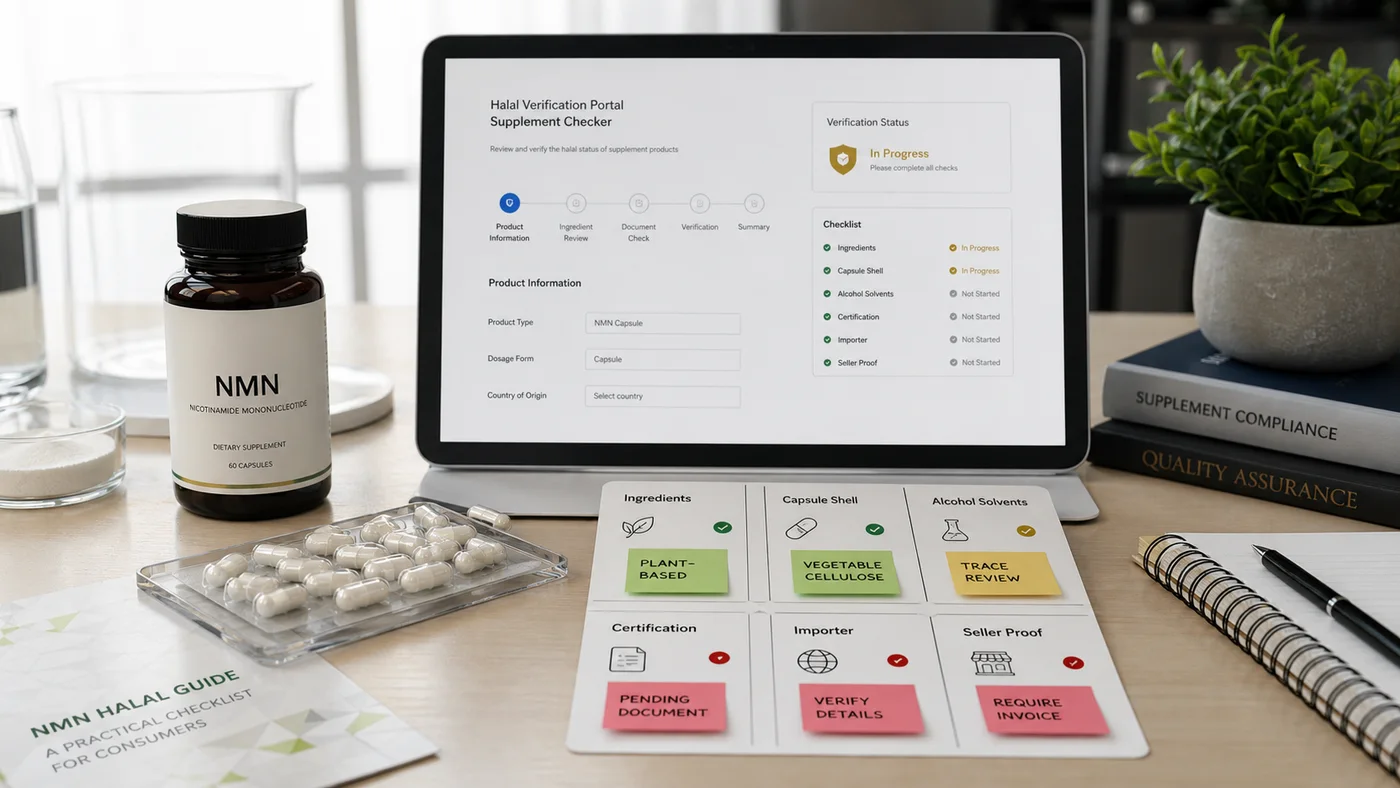
Here is the practical checklist a Malaysian Muslim buyer should run before purchasing any NMN supplement:
- Locate the MAL number on the bottle or outer box. Search it on Quest3+ (npra.gov.my). Confirm the brand and product name match.
- Check for a JAKIM halal logo. If present, note the logo style and certification number. Search halal.gov.my (e-Halal portal) for the manufacturer or product. Confirm the certificate is current.
- If no JAKIM logo, examine the capsule disclosure. HPMC, vegetable cellulose, or “vegan capsule” is the most reassuring non-certified option.
- Examine the excipient list. Look for magnesium stearate, stearic acid, or any animal-derived component. If the source is not specified, contact the brand or treat as syubhah.
- Check for a Certificate of Analysis (COA). Reputable brands provide a third-party assay confirming NMN purity and the absence of heavy metals.
- Cross-reference with reviewed brand listings. Our brands and where to buy pages summarise what each brand discloses publicly.
Foreign halal logos: how JAKIM recognition works
Malaysian halal recognition is centralised under JAKIM. The Department maintains a list of recognised foreign halal certification bodies whose marks JAKIM accepts as equivalent. That list changes over time and is published on halal.gov.my - so rather than trusting any static list, including ours, check JAKIM’s live recognised-bodies directory for the specific body and product category before you rely on an overseas logo.
- Indonesia. Since 2021, Indonesian halal certificates are issued by BPJPH (Badan Penyelenggara Jaminan Produk Halal), the government halal agency, while MUI (Majelis Ulama Indonesia) now issues the underlying halal fatwa rather than the certificate itself. JAKIM has historically recognised Indonesian certification for certain product categories, but recognition status should be verified case by case on halal.gov.my.
- Japan. Several Japanese bodies certify products for the export market, the best known being the Japan Halal Association (JHA). Recognition by JAKIM is partial and category-dependent, so confirm the specific body and category on JAKIM’s recognised-bodies list.
- Generic “halal” logos without a clear certifying body are not authoritative.
Self-declared halal versus certified halal
Some brands print “halal” or an Arabic word on the label without any certification body. This is a self-declaration, not a certification. The cautious approach is to treat self-declared halal as syubhah and verify the underlying ingredients yourself.
Syubhah: the doubtful category in practice
Syubhah is the Islamic legal category for matters where the halal-haram status is unclear. Applied to NMN supplements, this means:
- A clearly JAKIM-certified product is halal.
- A clearly porcine-gelatin product is haram.
- Everything in between - uncertified bovine, undisclosed excipients, foreign halal marks of uncertain recognition - is syubhah, and the cautious choice is to seek a clearer alternative.
For most Malaysian Muslim buyers, this means prioritising HPMC capsules with transparent excipient lists, even when full JAKIM certification is unavailable for the NMN category.
Vegetarian and vegan capsule alternatives in Malaysia
The good news for Malaysian buyers is that HPMC capsules have become the industry default for premium supplement brands worldwide. When you shop NMN, you can specifically search for terms such as “vegetable capsule,” “vegan capsule,” “HPMC,” or “plant cellulose” on the label. Several Malaysian and regional importers now stock NMN products explicitly formulated with HPMC capsules. Our where to buy page lists local pharmacies and verified e-commerce channels.
Advice for non-Muslim Malaysian readers
If halal is not part of your decision criteria, the verification workflow still benefits you:
- The NPRA MAL number is your safety baseline regardless of religion.
- HPMC capsules are also the preferred choice for vegetarians, vegans, and people with beef or pork allergies.
- Brands that pursue JAKIM certification typically also maintain higher documentation standards for purity and contaminant testing.
In other words, the halal verification workflow doubles as a quality-control workflow.
Our editorial commitments on halal claims
As a Malaysian NMN reference site, we commit to several principles that govern what readers can expect from our halal coverage:
- We will not name a specific brand as “JAKIM-certified” unless we have verified it on halal.gov.my on the date of publishing. Even then we add a caveat that certifications can lapse.
- We do not accept payment from brands for halal-status placement.
- We will cite official sources (halal.gov.my, npra.gov.my) over brand marketing or forum commentary.
If you encounter a halal claim you are unsure about, T Dinaiz re-checks halal claims on a schedule and logs significant corrections on the affected page.
Bottom line for Malaysian Muslim buyers and non-Muslim readers
NMN is a promising molecule with a growing scientific evidence base, but a halal NMN supplement is not the same thing as halal NMN the molecule. The supplement is the package - capsule, excipients, manufacturing chain - and that whole package must clear the halal bar. Most NMN brands sold in Malaysia today are not JAKIM-certified, which places them in the syubhah category by default.
Cautious Muslim buyers should prioritise HPMC capsules, transparent excipient lists, and verified NPRA registration, and should always search halal.gov.my and Quest3+ before buying.
Non-Muslim readers benefit from the same workflow because it is, in essence, a quality-control workflow. Verify, do not assume; consult halal.gov.my, not the marketing copy.