Buying nicotinamide mononucleotide in Malaysia in 2026 is no longer a niche pursuit. Walk through any Mid Valley pharmacy, scroll Shopee at midnight, or check your friend’s WhatsApp forwards, and NMN is everywhere. The supplement has graduated from biohacker forums into mainstream Malaysian wellness, which is good news and bad news at once.
The good news: choice is broader than ever, and prices have fallen meaningfully since 2023. The bad news: the flood of options has carried in counterfeits, under-dosed capsules, and listings that bypass Malaysian regulation entirely.
A confident first purchase does not require becoming an unpaid quality-control inspector. The pre-purchase checklist below covers the most common failure modes, the three channels Malaysians should actually consider-Shopee Mall, official brand ordering, and accountable pharmacy or distributor channels-and the practical side of storage, dosing strategy, and the scam patterns that have appeared in our local market.
By the end you will know exactly what to look for, what to walk away from, and what a fair price-per-gram looks like in ringgit terms.
Why the buying decision matters more than the brand
Most NMN articles obsess over which brand is “best”. That framing misleads first-time buyers because the variation between a well-made and a poorly-made bottle of the same brand can exceed the variation between brands.
A reputable Japanese manufacturer producing a third-party-tested 99.5% pure NMN powder is functionally similar to its Australian or American counterpart at the molecular level. What separates a good purchase from a bad one is rarely the logo on the bottle-it is whether the specific lot in your hands matches what was promised on the listing.
The clinical literature supports this priority. The pharmacokinetic and safety reviews that established NMN’s tolerability profile relied on pharmaceutical-grade powder with verified purity, not bargain-bin extracts.
When researchers gave older adults verified NMN for twelve weeks, the muscle and metabolic outcomes they observed assumed the substance in the capsule actually was NMN at the labelled dose. A capsule that is 60% NMN and 40% filler is not a cheaper version of the studied molecule-it is a different product.
So the real buying question is not “which brand?” but “how do I verify that what I am paying for is what I will swallow?” That verification rests on four checks: NPRA registration, a current Certificate of Analysis, transparent price-per-gram, and a credible halal claim if you require one. Get those right and brand selection becomes a matter of preference and budget rather than a gamble.
The pre-purchase checklist
1. NPRA MAL number - a strong plus when present
The National Pharmaceutical Regulatory Agency registers health supplements marketed for ingestion in Malaysia, and a registered product carries a MAL number on its box, formatted as eight digits followed by a letter category code.
A MAL number means the product has been through the NPRA’s quality, safety, and labelling assessment, so it is genuinely reassuring when you can find one - and it takes thirty seconds to verify.
Here is the realistic part, though: most NMN products on sale in Malaysia do not currently carry a MAL number, because NMN’s status as a registrable supplement is still unsettled with the regulator. Treating “no MAL number” as an automatic walk-away would reject almost every NMN listing on the market and contradicts the personal-import route discussed below.
So treat the MAL number as a bonus rather than a hard gate. When it is present, verify it; when it is absent, do not panic - shift your verification weight onto the third-party COA, the seller’s track record, and genuine reviews instead.
To verify a MAL number that is present, open the NPRA Quest3+ public search portal, type the number, and confirm three things: the product name on the portal matches the listing, the registration holder is a recognisable Malaysian company, and the status reads “Berdaftar” (Registered).
A “Dibatalkan” (Cancelled) or “Tamat Tempoh” (Expired) status, or a fabricated number that returns nothing, is a real red flag.
One pattern that still deserves caution: a seller who labels an ingestible product as a “research chemical” or “raw powder” specifically to dodge any consumer accountability, while pushing you to swallow it. The framing shift is a warning sign on its own - a serious seller of an ingestible NMN supplement will still stand behind the product with a COA and contactable business details.
2. A current third-party Certificate of Analysis
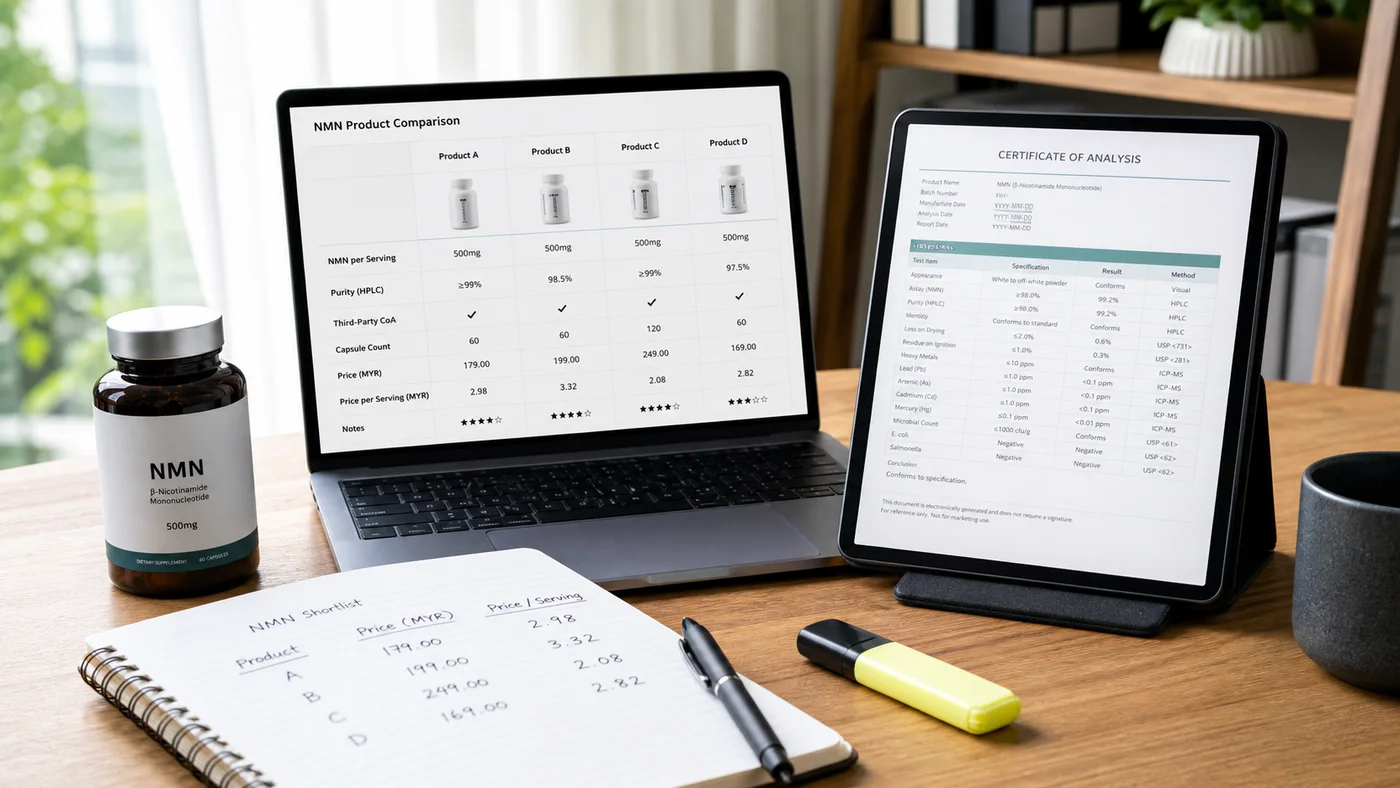
A Certificate of Analysis is a one or two-page laboratory report that documents what is actually in the powder. A trustworthy COA includes the lot or batch number (which should match the bottle you are buying), the date of testing, the name and accreditation of the testing laboratory, the assay method-HPLC is standard for NMN-and the measured purity.
For NMN the purity benchmark is ≥99%, with most pharmaceutical-grade material testing at 99.5% or higher.
Equally important is what the COA reports beyond purity: heavy metals (lead, arsenic, cadmium, mercury) within pharmacopoeial limits, microbial counts within safe ranges, and absence of common contaminants such as nicotinamide ribose (NR) substitution or melamine adulteration. If the COA only reports purity and nothing else, treat that as half a document.
Beware of COAs that are undated, lack a lot number, are issued by the brand’s own laboratory, or appear to be the same scanned image used across multiple product listings. Brands serious about quality publish lot-specific COAs and refresh them when stock rotates. Ask the seller for the COA matching the lot they will ship you, not a generic specimen sheet.
3. Halal status if that matters to you
In Malaysia, halal certification is granted by the Department of Islamic Development Malaysia (JAKIM) or by foreign halal bodies that JAKIM recognises. NMN itself, as a small organic molecule synthesised from non-animal precursors, is not inherently problematic.
The complications lie in the capsule shell (gelatin can be porcine), the excipients used during tabletting, and the cleanliness of the production line. A “vegan capsule” claim addresses the shell but says nothing about cross-contamination upstream.
If halal compliance is non-negotiable for you, look for the JAKIM logo on the packaging or a recognised foreign halal mark. The product’s MAL listing on Quest3+ also indicates halal certification status. Brands that have invested in JAKIM certification typically advertise it prominently, so its absence on a listing usually means the certification does not exist. For deeper background see our halal guide.
4. Plausibility of the dose claim
A reasonable daily NMN serving sits between 250 mg and 500 mg for general use, with some clinical protocols going higher. When a listing claims a 1,000 mg or 1,500 mg dose at a price far below comparable verified products, do the arithmetic and ask for a batch-specific COA.
The most useful consumer question is not whether a price is “too good” in the abstract, but whether the seller can prove identity, dose, purity, contaminants, and lot traceability for that exact bottle.
5. Price-per-gram in ringgit
Convert every listing to RM per gram of NMN. A 60-capsule bottle at 500 mg per capsule contains 30 grams; if it sells for RM 90, that is RM 3 per gram.
At the last editorial review, fair pricing for verified NMN in Malaysia sits at roughly RM 1.50 to RM 4 per gram depending on brand positioning, with official brand subscriptions sometimes landing toward the lower end before shipping and tax. Anything far below about RM 1 per gram deserves scepticism, because genuine COA-backed NMN cannot be produced sustainably at that price.
Channel comparison: where Malaysians actually buy
Shopee Mall
Shopee Mall sits one tier above the open Shopee marketplace. Sellers must be authorised brand owners or appointed distributors, and Shopee enforces a return policy of fifteen days for most categories. For NMN, Shopee Mall flagship stores operated by the brand itself are generally the safest entry point on the platform.
The trap on Shopee Mall is that the badge alone is not a quality guarantee for ingestibles. Verify the MAL number against the exact product variant you are buying, not the brand’s flagship hero product.
Official brand websites
Buying directly from a brand’s Malaysian website cuts out marketplace fees and often unlocks the freshest stock. Subscription discounts of 10 to 20% are common.
The trade-off is that you forego marketplace buyer protection, so confine official brand-site purchases to companies with verifiable business details, clear return terms, and current COA access. For a curated list of vetted operators see our brands directory and our where to buy locally guide.
For overseas official brand orders, check whether the product has Malaysian NPRA registration, whether the brand publishes lot-specific COAs, and whether the final landed price includes shipping, SST, handling fees, and possible duty. An overseas official store can be legitimate, but it does not replace local regulatory verification.
Pharmacy and named distributor channels
Mall pharmacy chains and named Malaysian distributors are useful when you want an accountable receipt, local return path, and a person to ask about storage, MAL status, and capsule ingredients. Do not assume a shelf location means live stock or clinical endorsement. Call ahead, ask for the exact brand and dose, and verify the same MAL number and COA before purchase.
How Malaysians pay for and protect the order
Once you have chosen a seller, the payment method you use is itself part of your protection. The general rule: keep the money inside a platform that has a dispute process, and avoid paying an unfamiliar seller by direct bank transfer.
- e-wallets and card. ShopeePay, Touch ‘n Go eWallet, and GrabPay all work at checkout and keep the transaction inside the Shopee platform, where you have a formal dispute channel. Paying a first-time seller directly by DuitNow or bank transfer outside the platform removes that safety net.
- Buy-now-pay-later. SPayLater, Atome, and similar BNPL options let you spread the cost of a larger bottle over instalments. Useful for cash flow, but only sign up for a recurring plan after you have tried the product and confirmed you tolerate it.
- Cash on delivery. COD, where a seller offers it, lets you pay only when the parcel arrives. It guards against non-delivery, but not against a bad product - you usually cannot inspect the contents before paying, so it does not replace checking the COA first.
- Shopee Guarantee and the return window. When you pay through the platform, the seller is not paid out until you confirm receipt, and Shopee Mall listings carry a return window (commonly fifteen days for most categories). Do not tap “Order Received” until you have checked the carton, seal, and expiry date.
- Time it around the big sales. Genuine discounts and stackable vouchers cluster around the 9.9, 11.11, and 12.12 sales, plus end-of-month payday campaigns. If you are not in a hurry, collecting platform and seller vouchers in the days before one of these dates can meaningfully lower your price-per-gram - just confirm the “before” price is real and not inflated for the sale.
How to read a Certificate of Analysis without a chemistry degree
A COA looks intimidating until you know which five fields actually matter. First, the product identity line-it should explicitly state “Beta-Nicotinamide Mononucleotide” or “β-NMN”, with CAS number 1094-61-7. Second, the lot number and manufacturing date. Third, the assay result-HPLC is the standard, look for ≥99.0% purity.
Fourth, the contaminant panel: heavy metals expressed in parts per million, microbial counts in colony-forming units per gram. Fifth, the issuing laboratory-names like Eurofins, SGS, Intertek carry weight.
If any of these fields is missing or illegible, ask the seller for a clearer copy. A seller who cannot produce one is telling you something important.
Scam red flags we have observed in the Malaysian market
Price too good to be true. A 60-capsule, 500 mg bottle (30 grams of NMN) listed at RM 25 works out to under RM 1 per gram and cannot contain authentic NMN at the claimed dose.
No verifiable documentation at all. A missing MAL number is common for NMN and not damning on its own - but a Malaysia-based seller who can produce neither a MAL number nor a lot-specific third-party COA nor identifiable business details has given you nothing to verify. That combination, not the missing MAL number alone, is the red flag.
No brand history. A brand that appeared on Shopee three months ago, has no website beyond the storefront, and uses stock photography is high-risk.
Generic or recycled COAs. Image-only PDFs, undated documents, missing lot numbers - all function as marketing rather than verification.
Pressure tactics. “Only 3 left at this price”, countdown timers, and WhatsApp-only checkout are textbook signals of an operation that does not want you pausing to verify.
Health claims that exceed the evidence. Listings that promise reversal of specific diseases, guaranteed weight loss, or “ten years younger in three months” violate Malaysian advertising rules. For an honest summary of what NMN can and cannot do, see our safety overview.
Storage in a tropical climate
NMN is hygroscopic-it pulls moisture from the air-and Malaysian humidity routinely exceeds 80%. Practical storage rules: keep the bottle in its original container with the silica desiccant, store at or below 25°C, and refrigerate once opened if your fridge has a dry compartment.
Do not freeze; the thaw cycle introduces condensation each time you open the bottle. A common mistake is decanting NMN into a weekly pill organiser for convenience-each compartment exchanges air with the room every time it is opened, accelerating degradation.
Bulk versus subscription
Bulk buying is the default impulse when you find a brand you trust, but in our climate it backfires. A six-month supply at the start of the year will degrade noticeably by month five. We recommend purchasing in three-month tranches as a maximum.
Subscription programmes from official brand sellers often offer 10–20% recurring discounts and ship fresher stock more frequently. A reasonable approach is to start with a one-month trial at full price, evaluate over six to eight weeks, and only then convert to a quarterly subscription.
Bottom line for Malaysian buyers
Buying NMN in Malaysia in 2026 is genuinely safer than it was three years ago, but only for buyers who do five minutes of verification work. The ranked priorities are: confirm the NPRA MAL number on the Quest3+ portal; obtain and read a lot-specific Certificate of Analysis; calculate price-per-gram in ringgit; verify halal status if you require it; and store the product in a way that matches our climate.
Channel choice-Shopee Mall flagship, official brand site, or accountable pharmacy/distributor-is a secondary decision driven by proof quality, convenience, price, and your tolerance for international shipping.
Skip these steps and you are gambling. Run through them and you can buy with the same confidence you would bring to any pharmacy purchase.