A Certificate of Analysis is the single most important document separating legitimate NMN from expensive white powder. Yet most Malaysian buyers never see one, and those who do often glance at the percentage and call it a day. Here is every line of a real NMN COA, what each value should be, and exactly what to demand from sellers before you spend RM200 on a bottle.
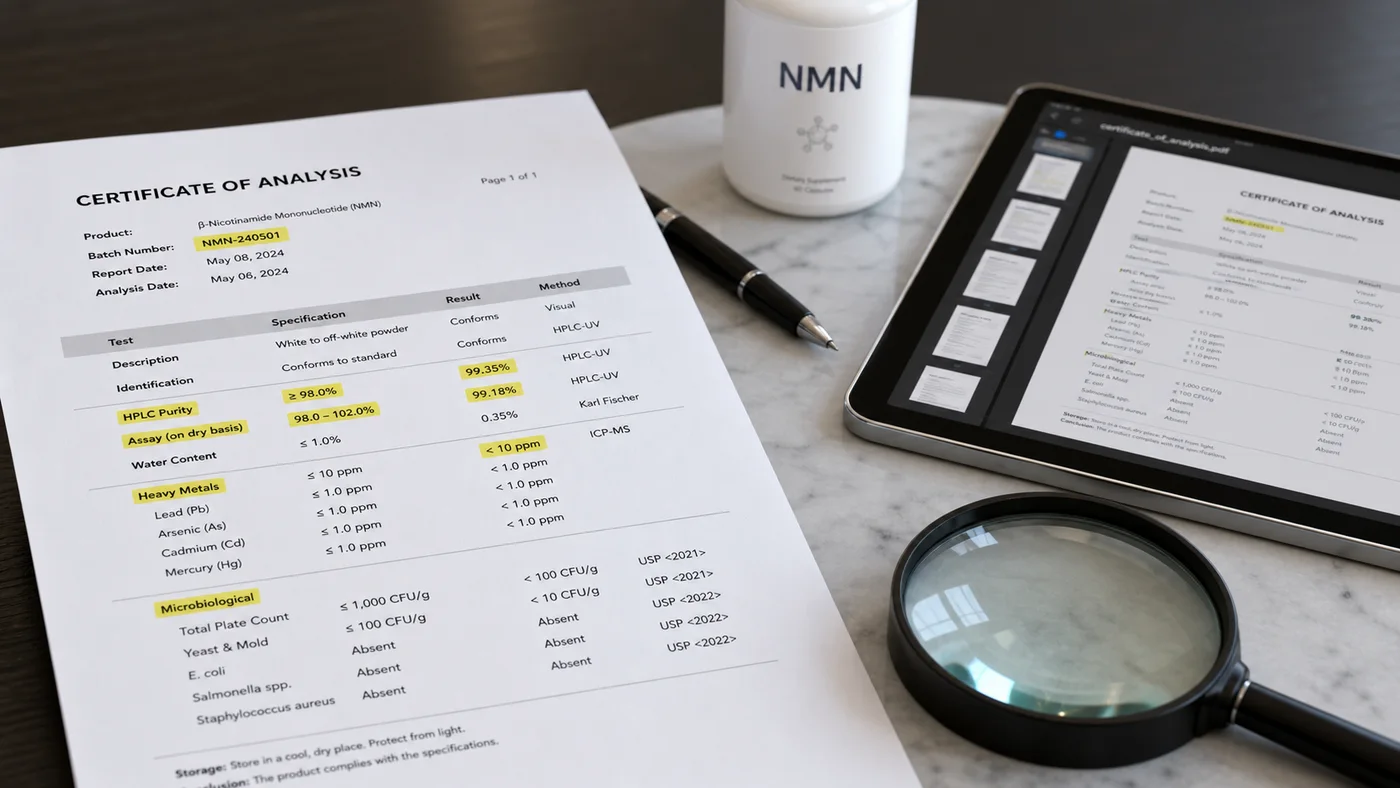
What a COA actually is
A COA is a laboratory report confirming that a specific batch of NMN powder matches its claimed identity, purity, and safety profile. It is not marketing material. It is not a generic manufacturer brochure. A real COA names a specific lot number, a specific test date, and a specific accredited laboratory.
If a seller cannot produce a batch-specific COA matching the bottle in front of you, the conversation should end there. For broader sourcing logic, see our buying guide.
Section 1: Product identity
The top of every legitimate COA states the chemical identity. For NMN (Beta-Nicotinamide Mononucleotide), look for:
- Chemical name: Beta-Nicotinamide Mononucleotide
- CAS number: 1094-61-7
- Molecular formula: C11H15N2O8P
- Molecular weight: 334.22 g/mol
The CAS number 1094-61-7 is non-negotiable. This is the unique global identifier for the beta-isomer of NMN, the only form with established bioavailability data. If the COA shows a different CAS or omits it entirely, the powder may be alpha-NMN, nicotinamide riboside, or simply niacinamide relabelled.
Section 2: Lot and batch information
Every COA must reference: lot or batch number (must match the printed bottle), manufacturing date, retest or expiry date, and quantity tested.
Cross-check the lot number on the COA against the bottle. A mismatch is the single most common red flag. Some sellers reuse one COA across multiple production runs, which is meaningless.
Section 3: HPLC assay and purity
This is the headline number. High-Performance Liquid Chromatography (HPLC) measures how much of the powder is actually NMN versus impurities or degradation products.
- Acceptable purity: ≥99.0%
- Premium grade: ≥99.5%
- Method: HPLC-UV at 260 nm (typical)
Anything below 99% is sub-pharmaceutical grade. The remaining 1% matters because degradation products like nicotinamide and ribose-5-phosphate can dominate at lower purities. Rajman et al. (2018) emphasised that clinical NMN benefits assume high-purity input.
Section 4: Heavy metals
Per US Pharmacopeia and Malaysian NPRA guidance for nutraceuticals, heavy metal limits should read:
- Lead (Pb): <0.5 ppm
- Arsenic (As): <1.0 ppm
- Cadmium (Cd): <0.5 ppm
- Mercury (Hg): <0.1 ppm
Chinese-sourced NMN (most global supply) carries genuine heavy-metal risk from manufacturing solvents. A COA without a heavy metals panel is incomplete.
Section 5: Microbial limits
- Total aerobic count: <1000 CFU/g
- Yeast and mould: <100 CFU/g
- E. coli: absent in 1g
- Salmonella: absent in 10g
These figures align with NPRA microbiological standards for oral supplements.
Section 6: Accredited laboratory
The COA must be issued by an ISO 17025-accredited third-party laboratory. Trusted names: Eurofins (global, most common for NMN), SGS (global), Intertek (global), TUV (Europe).
In-house manufacturer COAs are acceptable as supporting documents but should be paired with at least one third-party report per year. Visit our brands page for vendors who publish third-party COAs by default.
What to ask the seller
- Send me the COA matching lot number printed on this exact bottle.
- Confirm CAS 1094-61-7 appears on the document.
- Confirm purity ≥99% by HPLC.
- Show me the third-party heavy metals panel.
- Name the accredited laboratory and provide their accreditation number.
Sellers who hesitate, send screenshots without lot numbers, or claim COAs are “trade secrets” are not selling pharmaceutical-grade NMN.
Regulatory context in Malaysia
NPRA registration is not the same as batch-level purity testing, so consumer-side COA review still matters. US FDA material on NMN has shifted since the 2022 drug-preclusion dispute, with 2025 petition-response material stating that NMN is not excluded from the US dietary supplement definition. JAKIM halal certification does not assess chemical purity, only halal permissibility and related process controls. The COA remains your main consumer-side defence. Read our safety page for full risk context.
Bottom line for Malaysian readers
A COA you cannot read is just a sheet of paper with logos. Spend five minutes learning the six fields above and you will spot fake or stale COAs faster than the average pharmacist. A bottle with a clean, recent, batch-matched, third-party-issued COA earns its premium. Everything else is a gamble.